
Catégorie : Activités/News
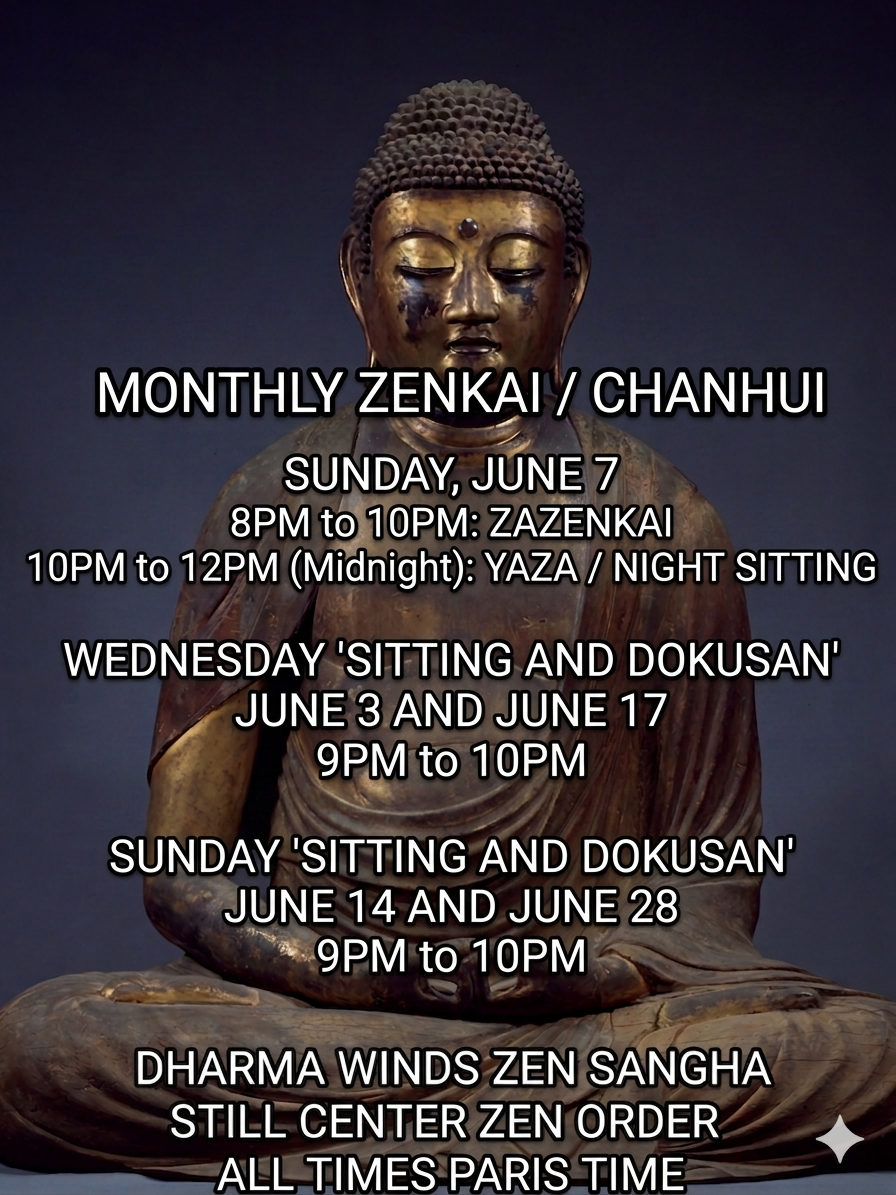
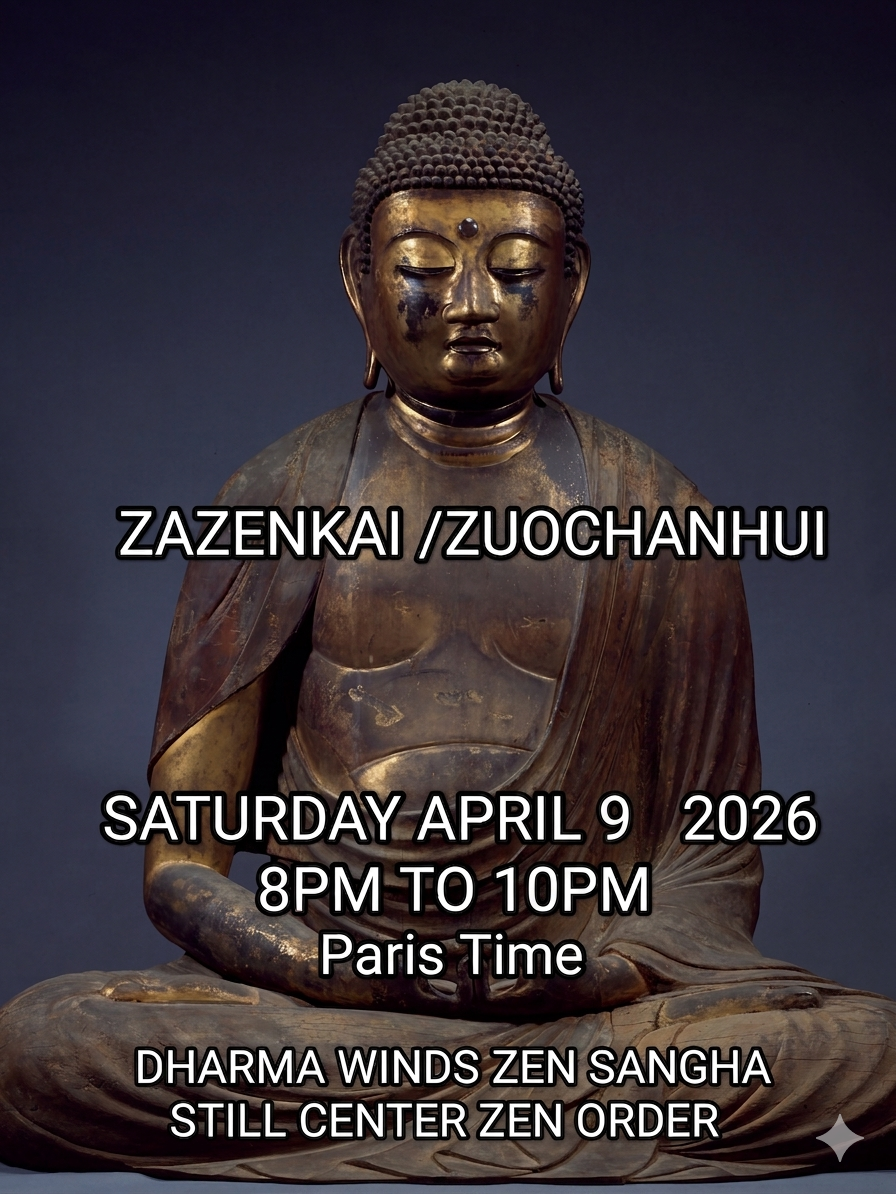
May Zazenkai
Our next Monthly Zazenkai
On our Discord server and Jitsi Room.
The Sound that is Practice
I tried putting my notes on the actual practice Uchiyama Roshi is developing in his book, « The Sound that perceives the World » about the combined practice of recitation and silent illumination.
I came up with this small text, with the help of AI for the final editing.
The end result is very close to my original notes, without the typos and repetitions.
See how close our original practice, based in Chan and Soto Zen is from what Uchiyama describes in his book. Of course these are my words, but believe all these concepts are from HIS practice.
If only Soto Zen mainstream realized how recitation is compatible with zazen.
We are lucky it is our practice so, let’s shine that light.
I strongly advise you to read this book, it gives a Pureland Soto Zen perspective on our combined practice of recitation and zazen with conclusions that are exactly what we teach!
The Sound That Is Practice
A Practical Guide to Chanting, Hearing, and Zazen
This practice begins with something very simple: sound and hearing. Instead of starting from posture or breath, we begin from the fact that hearing is already happening. There is no need to create a special state or prepare the mind in a special way. Sound is present, and hearing is present. Practice starts there.
When you chant, for example Namu Kanzeon Bosatsu, do not think of it as calling out to something outside yourself. Do not imagine that you are sending your voice toward a distant figure or trying to reach a goal. In this practice, chanting is not directed outward and it is not a means to obtain something. It is simply the full expression of this moment.
Let the chant arise from the whole body. Speak the words clearly and steadily, without rushing and without dragging them out. There is no need to control the breath in any particular way. The breath will take care of itself if you do not interfere. What matters is that the chant is complete in each moment, neither forced nor held back.
At the same time, hearing is already taking place. You do not need to “start listening” as something separate. The essential point is not to divide chanting and hearing into two activities. Do not chant first and then listen afterward. Do not create a position from which you observe the sound. The sound and the hearing of that sound occur together as a single event.
Remain with this: the sound that hears itself.
At first, it will feel as though you are the one who is chanting. This is natural. There is no need to try to remove this feeling or replace it with something more refined. If you try to get rid of the sense of “I,” you only add more effort and complication. Instead, simply continue chanting and hearing.
If the chant is allowed to be complete, without interference, the sense of a separate doer may begin to loosen on its own. The chanting continues, but it feels less like something you are managing or controlling. This is not something to aim for, and not something to hold onto. If you notice it, let it be and continue.
During practice, many things will arise. Thoughts, memories, plans, distractions, dullness, resistance—these are all part of the mind’s activity. Do not treat them as problems. Do not try to push them away, and do not follow them. Most importantly, do not keep correcting yourself again and again. When you notice that attention has wandered, simply return to the chant by chanting. No judgment is needed. Each repetition is complete in itself.
Do not turn this practice into a search for calm, clarity, or insight. These may appear, but they are not the point. If you chase after them, you leave the immediacy of the practice. What matters is to be fully present with the chanting and hearing exactly as they are, without adding anything extra.
It is important to understand clearly that chanting and zazen are not two separate practices. When chanting is done completely—without directing it outward, without dividing chanting and hearing, without adding a watcher—the activity of chanting is already zazen. Zazen does not begin when the voice stops. Zazen is the same practice, without relying on the voice.
If chanting continues naturally in this way, it may at some point slow down or come to an end by itself. This should not be forced. Do not decide to stop. Let the chant fade on its own, like the sound of a bell gradually disappearing into the surrounding space. When the chant fades, nothing new is introduced and nothing is lost. What remains is simply hearing without sound, awareness without an object, sitting without doing. This is zazen.
In this way, chanting naturally opens into silent sitting. But this does not mean that chanting is a preparation and zazen is something higher or more advanced. They are the same practice expressing itself in two forms: with sound and without sound. If this is understood, there is no gap between them.
When you sit in zazen, do not think that you are changing methods. Do not think, “Now I stop chanting and start zazen.” The same principle continues. In chanting, sound and hearing are not divided. In zazen, even if there is no spoken sound, hearing is still present. Sounds may arise—distant noises, the movement of the body, the rhythm of the breath. Do not focus on them and do not reject them. As in chanting, do not divide what is happening and do not create a watcher who stands apart. Zazen is simply the continuation of complete participation, without adding anything.
This unity is not limited to formal practice. Whether chanting, sitting, walking, or working, the same practice continues. Do not think that chanting is one practice, zazen another, and daily life something else. There is only one practice: complete presence without division. You may chant during daily activities, or there may be no chanting, or you may be sitting quietly. The outer form changes, but the essential point does not.
In this practice, Kannon is not understood as an external being. Kannon refers to the functioning of hearing itself, the complete openness to what is present. To chant Namu Kanzeon Bosatsu is not to call something from outside. It is to enact this very functioning of hearing and responding. When chanting and hearing are not divided, this functioning is already complete. Whether there is sound or silence, nothing is lacking.
Do not measure your practice. Do not ask constantly whether you are doing it correctly or whether it is working. These thoughts only add another layer of activity. The instruction remains simple: continue. Good conditions and difficult conditions are not different in essence. Noise, fatigue, distraction, discomfort—these are not obstacles. They are the field of practice itself. There is no need to wait for better circumstances.
Chant fully and hear fully. When chanting is complete, it is zazen. When chanting falls away, it is still zazen. There are not two practices. There is only this.
Introduction to the Practice of Zen by Daiho Hilbert Roshi
We are sincerely happy to announce that a new booklet of Introduction to the Practice of Soto Zen in the lineage of the Clear Mind Zen Order (of which our Still Center Zen Order is a Branch) has been recently released on our website’s Zen Texts/Ressources Page.
This booklet is an almost Verbatim version of a series of four teachings given by Harvey Daiho Hilbert Roshi in 2025, initially called Zen Buddhism 101. In it, he goes through some of the main questions one can ask himself regarding the practice of Soto Zen in the lineage of Soyu Matsuoka Roshi in a very personal and intimate way. Far from being a dry exposition of the practice, it is with his own words and feelings that Daiho Roshi explains the mains aspects of our practice.
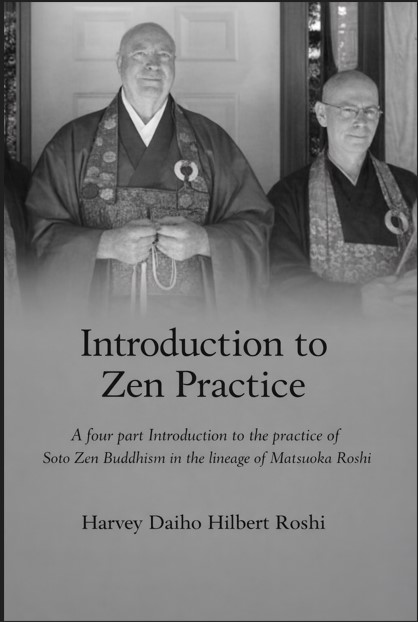
It’s a fabulous booklet based on a lifetime of sincere practice. We sincerely hope you will enjoy this booklet.
It is now part of the Curriculum for our student taking Bodhisattva vows and Novice Priest/Monk Ordination.
It can also be found on our Zen Texts/Ressources Page.
Another True Gem for future Chan/Zen students of our Sangha.
With Deep Bows,
Amita Fu!
Chan Practice of the Dharma Fox
We are very happy to share that QianMen Shakya (Rev. Ivan Yumon Ferencak) leader of the German Branch of our Sangha, who became a Priest in our Chan lineage recently and his currently training to become a Priest in our Soto Zen lineage, has put recently put together (with the help of one of his students, Rachel Al Daher (LianJian / RenJin), a booklet based on a series of teachings he gave exposing the main methods of our Tradition.
Originally given in German to our German Sangha, these teachings have been translated by Rachel.
This Booklet is now available on our website at our Zen Texts/Ressources Page as well as clicking here.
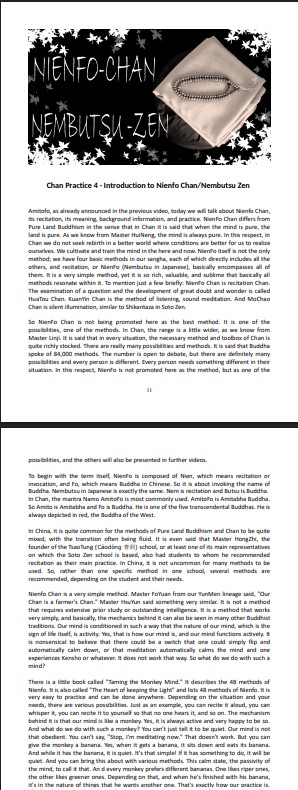
We sincerely hope you will enjoy this booklet. It is now part of the Curriculum for our student taking Bodhisattva vows and Novice Priest/Monk Ordination. Its a fabulous booklet both very simple and direct yet wonderfully complete and based on years of serious practice. A true Gem for future Chan/Zen students of our Sangha.
With Deep Bows,
Amita Fu!
Clergy Members
CLERGY MEMBERS OF THE DHARMA WINDS ZEN SANGHA
Spiritual Head of Dharma Winds Zen Sangha
Tim RyuKo Langdell Roshi (YinGuang Shakya) – Founder of Still Center Zen Order
Prior of Dharma Winds Zen Sangha
Yao Xin Shakya (Luis KaiUn Lista) – Founder of Dharma Winds Zen Sangha
Transmitted Priests of Dharma Winds Zen Sangha
Fa Geng Shakya (Massimiliano Milesi) – Prior of our Italian Sangha (Hokke Sangha)
Qian Men Shakya (Ivan YuMon Ferencak) – Prior of our German Sangha (Dharma Fox Zen Hermitage)
Assistant Dharma Teachers (ch. JiaoYuen, jp. Shusso) of Dharma Winds Zen Sangha
Rev. ShenYun (Mark Gilenson) – Prior of Bodhi and Bass Zen Hermitage
Novice Priests in Training of Dharma Winds Zen Sangha
Br. ShenGuang (Chris Johnson) – 2022
Br. ShenDao (Luis Carlos Barrera) – 2021
Br. ShenHai (James Eke) – 2021
Br. ShenFa (Frederic Loesch) – 2021
Br. ShenZhi (Axel Weith) – 2021
Sr. ShenNa (Lena Savarit) – 2017
Br. ShenYin (Yuri Reis) – 2017
Br. ShenHai (David MyoXin Guglielmi) – 2016
Retired Clergy Members
QianMing Shakya (Daniel Scharpenburg) – 2018
Br. ShenHai (James Kavajcek) – 2017
Celebration month, New Apprentice Dharma Teacher and Celebrating the Buddha’s Enlightenment through a night of Chan/Zen sitting
The month of November is always a special time of the year for our Sangha.
First, this is the month of the year in which we celebrate our Original Order’s anniversary. The Zen Buddhist Order of HsuYun, was founded on November 8 1997 by Great Master BenMiao Zhiding (Jydin) Shakya and ChuanYuan MingZhen Shakya with ChuanZhi Shakya has its first Western Abbot.
The Order was under the authority of the Hawaii Buddhist Association like the HsuYun Temple of Honolulu, both lead by our founder Great Master BenMiao Zhiding (Jydin) Shakya.During this month, we especially remember our dear teacher, ChuanYuan MingZhen Shakya (Emma Barrows) who passed into Nirvana on November 19th 2016. We are grateful for her wonderful teachings and the light of loving presence still shines in our community.
Secondly, this Sunday we had a ZuochanHui/ZazenKai that was a bit special for the Sangha. Indeed, we celebrated the anniversary of our original Zen Buddhist Order of HsuYun with the Apprentice Dharma Teacher Ceremony of Rev. Shenjing. Having completed the Novice curriculum, Rev. Shenjing was named a Head Novice/Apprentice Dharma Teachers and vowed to dedicate his life further on the path of teaching and sharing the practice.
We also are proud to announce that to celebrate the Buddha’s enlightenment we’ll have our traditional all night sitting.
This year, we’ll sit all night from Saturday 9th 21h30 to Sunday 10th 7pm (Paris time), alternating 25 min sitting, walking, sitting, as usual… For the first time ShengJing will be the one leading the night sitting.
As you may have noted, sitting won’t be on Sunday but on Saturday, in order for more people to be able to participate.
Feel free to come and sit for the all night or just a sitting as you can.

Every being, Burning from the same fire, One Buddha!
Silly Yaoxin,
Amituofo!

November 2021 Ordination announcement
The month of November is always a special time of the year for our Sangha.

First, this is the month of the year in which we celebrate our Original Order’s anniversary. The Zen Buddhist Order of HsuYun, was founded on November 8 1997 by Great Master WeiMiao JyDin Shakya and ChuanYuan MingZhen Shakya with ChuanZhi Shakya has its first Western Abbot. The Order was under the authority of the Hawaii Buddhist Association like the HsuYun Temple of Honolulu, both lead by our founder Great Master WeiMiao Jydin Shakya.
This was also the day of our Chan Order first ordination ceremony, 24 years ago.
Secondly, this is the month were we celebrate the Ancestors and Ghosts Ceremony, some of our local groups perform the ceremony at Halloween. It is a special time to remember those who have left and to dedicate the merit of our practice to all beings, material and imaterial who need the Dharma.
During this month, we especially remember our dear teacher, ChuanYuan MingZhen Shakya (Emma Barrows) who passed into Nirvana on November 19 2016. We are grateful for her wonderful teachings and the light of loving presence still shines in our community.
Thirdly, this Sunday 7th November four new clergy brothers have received Novice Priest Ordination, completing their initial study and practice and marking their entry into our sangha’s clergy.
We warmly welcome:
Br. ShenDao 深道 – Profound Way
Br. ShenHai 深海 – Profound Ocean
Br. ShenFa 深法 – Profound Dharma
Br. ShenZhi 深智 – Profound Wisdom

May those new Novice Priests be the future pillars of the tradition as the dedication of merits of the ordination ceremony says so well.
Deep and humble bows to each one of them!
Thanks to them for being the next generation.
Dear brothers, welcome in this humble path of study and practice.
May each one of you study the Way with One Body/Mind and serve others!
One Precept!
Reveal the Source,
Save all beings.
AmituoFo !
AmituoFo !
AmituoFo !
A Conversation with Hsu Yun by John Blofeld
A Conversation with Hsü Yün
After living with Uncle for a few months and continuing my lessons to private students, I felt a great urge to travel again, if only for a few days. I had just been reading the Sutra of Hui Nêng (Wei Lang) which relates how a reputedly illiterate man became Sixth Patriarch of the Zen Sect well over a thousand years ago. Another monk had composed a poem comparing an enlightened mind to a bright mirror on which no dust (illusion) can collect. On having this read to him, Hui Nêng replied with another poem in which he declared that the ‘mirror’ has no existence and asked whereon such dust can collect. In this way he expressed his intuitive understanding of the voidness of all phenomena, including both illusions and the separate minds of individuals. This expression of enlightened understanding of Zen’s deepest truth won for him the Fifth Patriarch’s symbolical robe and bowl. After his death all those centuries ago, his body had miraculously resisted decay and, according to widespread belief, was still to be seen at the Nan Hua Monastery in North Kwangtung…
… The present Abbot was no other than the Venerable Hsü Yün (虚云 / Xū Yún), who was believed to be well over a hundred years old, though still able to walk as much as thirty miles a day. He was renowned all over China as the greatest living Master of Zen; so I was delighted to hear the unexpected news that he had just returned after an absence of several months spent in a distant province. Not long after my arrival, I excitedly followed the Reverend Receiver of Guests to pay my respects to this almost mythical personage. I beheld a middle-sized man with a short, wispy beard and remarkable penetrating eyes. He was not precisely youthful-looking as I had been led to expect, but had one of those ageless faces not uncommon in China. Nobody could have guessed that he was already a centenarian. Finding myself in his presence, I became virtually tongue-tied and had to rack my brains for something to say, although there was so much I could profitably have asked him. At last, I managed to ask:
“Is this famous monastery purely Zen, Your Reverence?”
“Oh yes,” he answered in a surprisingly vigorous voice. “It is a great centre of Zen.”
“So you do not worship Amida Buddha or keep his statue here?”
The question seemed to puzzle him, for he took some time to reply.
“But certainly we keep his statue here. Every morning and evening we perform rites before it and repeat the sacred name while circumambulating the altar.”
“Then the monastery is not purely Zen,” I persisted, puzzled in my turn.
“Why not? It is like every other Zen monastery in China. Why should it be different? Hundreds of years ago there were many sects, but the teachings have long been synthesized – which is as it should be. If by Zen, you mean the practice of Zen meditation, why, that is the very essence of Buddhism. It leads to a direct perception of Reality in this life, enabling us to transcend duality and go straight to the One Mind. This One Mind, otherwise known as our Original Nature, belongs to everybody and everything. But the method is very hard – hard even for those who practise it night and day for years on end. How many people are prepared or even able to do that? The monastery also has to serve the needs of simple, illiterate people. How many of them would understand if we taught only the highest method? I speak of the farmers on our own land here and of the simple pilgrims who come for the great annual festivals. To them we offer that other way – repetition of the sacred name – which is yet the same way adapted for simple minds. They believe that by such repetition they will gain the Western Paradise and there receive divine teaching from Amida Buddha himself –teaching which will lead them directly to Nirvana.”
At once reluctantly and somewhat daringly I answered: “I see. But isn’t that a kind of –well, a sort of – of – er – deception? Good, no doubt, but…”
I broke off, not so much in confusion as because the Venerable Hsü Yün was roaring with laughter.
“Deception? Deception? Ha, ha, ha, ha-ha! Not at all. Not a bit. No, of course not.”
“Then Your Reverence, if you too believe in the Western Heaven and so on, why do you trouble to teach the much harder road to Zen?”
“I do not understand the distinction you are making. They are identical.”
“But…”
“Listen, Mr P’u. Zen manifests self-strength; Amidism manifests other-strength. You rely on your own efforts, or you rely on the saving power of Amida. Is that right?”
“Yes. But they are – I mean, they seem – entirely different from each other.”
I became aware that some of the other monks were beginning to look at me coldly, as though I were showing unpardonable rudeness in pertinaciously arguing with this renowned scholar and saint; but the Master, who was quite unperturbed, seemed to be enjoying himself.
“Why insist so much on this difference?” he asked. “You know that in reality there is nothing but the One Mind. You may choose to regard it as in you or out of you, but “in” and “out” have no ultimate significance whatever – just as you, Mr P’u, and I and Amida Buddha have no real separateness. In ordinary life, self is self and other is other; in reality they are the same. Take Bodhidharma who sat for nine years in front of a blank wall. What did he contemplate? What did he see? Nothing but his Original Self, the true Self beyond duality. Thus he saw Reality face to face. He was thereby freed from the Wheel and entered Nirvana, never to be reborn – unless voluntarily as a Bodhisattva.”
“Yet, Reverence, I do not think that Bodhidharma spoke of Amida. Or am I wrong?”
“True, true. He did not. But when Farmer Wang comes to me for teaching, am I to speak to him of his Original Self or of Reality and so on? What do such terms mean to him? Morning and evening, he repeats the sacred name, concentrating on it until he grows oblivious of all else. In time, after a month, a year, a decade, a lifetime or several lifetimes, he achieves such a state of perfect concentration that duality is transcended and he, too, comes face to face with Reality. He calls the power by which he hopes to achieve this Amida; you call it Zen; I may call it Original Mind. What is the difference? The power he thought was outside himself was inside all the time.”
Deeply struck by this argument and anxious, perhaps, to display my acquaintance with the Zen way of putting things, I exclaimed:
“I see, I see. Bodhidharma entered the shrine-room from the sitting-room. Farmer Wang entered it through the kitchen, but they both arrived at the same place. I see.”
“No,” answered the Zen Master, “you do not see. They didn’t arrive at any place. They just discovered that there is no place for them to reach.”
An Extract from The Wheel of Life by John Blofeld, Rider and Company, 1959
Source: https://thebamboosea.wordpress.com/2012/11/03/a-conversation-with-hsu-yun-john-blofeld/
 Dharma Winds Zen Sangha