Mountain Liturgy

Le bonze en entrainement Kuoshou nous propose une manière simple d’adapter notre pratique quotidienne à la nature, afin de faire de notre pratique un pèlerinage sur la montagne intérieure.

Amituofo !

YaoXin Shi


Mountain Liturgy

Nature is a place in which we can experience rebirth of mind, body and spirit. But just putting on your hiking shoes and tuning your I-phone or I-pod to your favorite beats is not what I am taking about. What I am talking about is taking the practice out of the meditation hall and using it in a natural non-man-made setting. It does not always mean that you have to find high mountain peaks or deep mountain valleys, but rather someplace that is not traveled so often and is peacefully nature. It could be a walk through a thicket of spruce or cottonwood in the neighborhood park, along river or creek near your home or even a stroll along the beach. Or possible is you have a large plot of land or a large garden there you have it. This is the first thing that one needs to find to start the practice of Mountain Liturgy (or Natural Liturgy). Second one should cleanse their mind of negative thoughts and feelings, if you can from any thoughts and feelings perfect, if not perfect too. I use a breathing technique in which I concentrate on my breathing.

Cleansing Breathe:

Stand straight and fully erect, keeping your shoulders set back and stomach in.

Place your hands, palms touching your abdomen, one on each side of your navel.

Breathe in through your nose, letting your chest fill and expand, exhale through mouth deflating your lungs.

Concentrate on you breathing, Inhale should be about four seconds, holding breathe should be about six seconds and the exhale should be around eight seconds and the point between exhale and inhale should be about four seconds. Repeat this ten to fifteen times.

This technique is use to one help exercise the lungs and abdomen and two you slow the wondering mind so the one may be able to experience nature in full mindfulness.

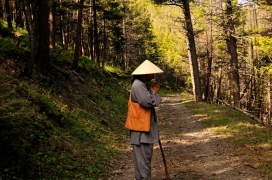
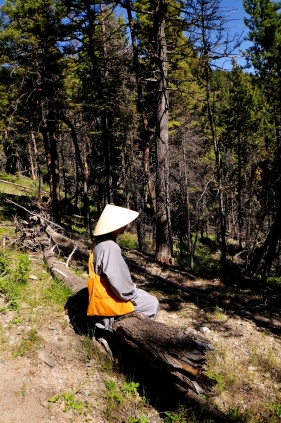
What should you wear? Well that is up to you for the most part. If you are making this apart of you practice then please wear something comfortable, loose fitting clothes, a good hat, good shoes and a walking stick (including if where your walking is rocking and rough). Now if you are a student who is preparing to do a pilgrimage, I would advise taking to you teacher or institute, because each sect, group and or rank has different rules. At least in my case, for lay and non-Buddhist practitioners that wish to do a mountain liturgy I just require and open mind, wear what is comfortable and open yourself up. For monks, nuns, and priest it depends on their order’s rules. That being said formal students of mine to whom in the future who do wish to seek the monastic life or priesthood, a simple monastic work outfit, a hat to cover the head, zori or sandles (of decent quality), walking staff, a monks bag and to be humble.

Now this practice is free for all to use. It follows in many way the daily liturgy, only this time you are walking in mindfulness. Now if you are non-Buddhist it is okay, if you feel comfortable just doing simple contemplation and meditations you can, also you can replace the Heart Sutra and Kannon Sutra with a personal prayer of your own or own you have already learned. This practice it for all of us. To bring back into balance our heart, mind and body.

DSC_6308_008

Ryoo Zan An Mountain Liturgy 

Simple Practice:

Three deep bows toward the trail or path you are getting ready to start down.

Light incense

Three more deep bows.

DSC_6341_016

Consider the Repentance Chant. Remember to keep you breathing as your step, even and smooth. The first place that feels right to you, that stirs something deep down make an offering of incenses, Bow Deeply completing the Repentance Chant, Three Refuges and Fours Vows section. Before continuing on your way after you have complete the recitations make gassho and bow deeply again.

Repentance Chant

Verse of Atonement

All my ancient, twisted Karma,

From beginningless greed, hate, and delusion,

Born through body, speech and mind,

I now fully avow

Three Refuges

One deep bow after each sentence:

I take refuge in Buddha.

I take refuge in Dharma.

I take refuge in Sangha.

Four Vows 

Repeat 3xs

To save all sentient beings,though beings be numberless,

To transform all delusions, though delusion is inexhaustible,

To perceive Reality, though Reality is boundless,

To attain the Enlightened Way, a way non-attainable.

Namu Daishi Henjo Kongo

Namu Daishi Henjo Kongo

Namu Daishi Henjo Kongo

Coming to the right place(s) find a comfortable but not to comfortable and start to either meditate or contemplate. If you have time, which I hope you do, then do both. Then using the same place or even on your return walk (only if you have it memorized) you can recite the Heart Sutra (Hannya Shingyo) and the Kannon Sutra.

DSC_6347_021

Meditation

The time amounts of each is variable depending on your physical ability. Please do not strain yourself. If you cannot do the following time allotments shorten them up and slowly work your ways up.

15-30 minutes of meditation
10 minutes of slow walking meditation)
15-30 minutes of contemplation

Heart Sutra: Hannya Shingyo

(Japanese)

Maka Hannya Haramita Shingyou

Kan Ji Zai Bo Satsu Gyo Jin Hannya Hara Mita Ta Ji Sho Ken Go On Kai Ku Do I Sai Ku Yaku Sha Ri Shi Shiki Fu I Ku Ku Fu I Shiki Shiki Soku Ze Ku Ku Soku Shiki Ju So Gyo Shiki Yaku Bu Nyo Ze Sha Ri Shi Ze Sho Ho Ku So Fu Sho Fu Metsu Fu Ku Fu Jo Fu Zo Fu Gen Ze Ko Ku Chu Mu Shiki Mu Ju So Gyo Shiki Mu Gen Ni Bi Ze Shin Ni Mu Shiki Sho Ko Mi Soku Ho Mu Gen Kai Nai Shi Mu I Shiki Kai Mu Mu Myo Yaku Mu Mu Myo Jin Nai Shi Mu Ro Shi Yaku Mu Ro Shi Jin Mu Ku Shu Metsu Do Mu Chi Yaku Mu Toku I Mu Sho Tok Ko Bo Dai Satta E Hannya Hara Mita Ko Shin Mu Kei Ge Mu Kei Ge Ko Mu U Ku Fu On Ri Issai Ten Do Mu So Ku Gyo Ne Han San Ze Sho Butsu E Hannya Hara Mita Ko Toku A Noku Ta Ra San Myaku San Bo Dai Ko Chi Hannya Hara Mita Ze Dai Jin Shu Ze Dai Myo Shu Ze Mu Jo Shu Ze Mu To Do Shu No Jo Issai Ku Shin Jitsu Fu Ko Ko Setsu Hannya Hara Mita Shu Soku Setsu Shu Watsu Gya Tei Gya Tei Ha Ra Tei Hara So Gya Tei Bo Ji Sowa Ka Hannya Shin Gyo

(English)

In the near future I upload an audio on the Hannya Haramita Shingyo. If you wish to use this Japanese version and have question on pronunciations please contact me and I will be more than happy to help you with recitation.

Avalokiteshvara bodhisattva when practicing deeply the prajna paramita perceived that all five skandas are empty and was saved from all suffering and distress.
O Shariputra, form does not differ from emptiness; emptiness does not differ from form, that which is form is emptiness; that which is emptiness, form. The same is true of feelings, perceptions, impulses, consciousness.
O Shariputra, all dharmas are marked with emptiness; they do not appear, nor disappear, are not tainted not pure, do not increase nor decrease.
Therefore in emptiness, no form, no feelings, no perceptions, no impulses, no
consciousness, no eyes, no ears, no nose, no tongue, no body, no mind; no color, no sound, no smell, no taste, no touch, no object of mind; no realm of eyes and so forth until no realm or mind consciousness; no ignorance and also no extinction of it, and so forth until no old age and death and also no extinction of them; no suffering, no origination, no stopping, no path, no cognition, also no attainment.
With nothing to attain the bodhisattvas depends on prajna paramita and the mind is no hindrance. Without any hindrance no fears exist; far apart from every perverted view the bodhisattva dwells in nirvana.
In the three worlds all Buddhas depend on prajna paramita and attain unsurpassed complete perfect enlightenment.
Therefore know the prajna paramita is the great transcendent mantra, is the great bright mantra, is the utmost mantra, is the supreme mantra, which is able to relieve all suffering and is true, not false. So proclaim the prajna paramita mantra, proclaim the mantra that says:

“GATE GATE, PARAGATE, PARASAMGATE BODHI! SVAHA!”

Kanzeon Sutra in 10 lines

Kanzeon! Veneration to the Buddha!
With Buddha I have origin;
With Buddha I have affinity;
Affinity with Buddha, Dharma, Sangha;
Constancy, joy, self, and purity.
Mornings, my thought is Kanzeon;
Evenings, my thought is Kanzeon.
Thought after thought arising in mind.
Thought after thought not separated from mind.

Upon finishing your walking liturgy turn back to the path or trail you are leaving and put your hands in Gassho and close by reciting the Transfer of Merit Chant and Close with three deep bows.

Transfer of Merit Chant

We pray to all the Buddhas, all the Bodhisattva-Mahasattvas in the ten quarters, of the past, present, and future, and to Mahaprajna-paramita, that by virtue of this merit universally prevailing, not only we but all beings shall equally attain Buddhahood.

Namu Daishi Henjo Kongo

Closing

Three low bows

So why do I always say three deep bow, three represents our Refuge Vow, We Bow is appreciation and respect to Buddha, We Bow is appreciation and respect to Dharma, We Bow is appreciation and respect to Sangha. This is why.

Should you have any questions or are looking for formal training please feel free to contact me through the contact section of this blog.

Namu Daishi Henjo Kongo

光蔵 (Kozou)


Avatar de KozouRyoo Zan An 龍山庵

Nature is a place in which we can experience rebirth of mind, body and spirit. But just putting on your hiking shoes and tuning your I-phone or I-pod to your favorite beats is not what I am taking about. What I am talking about is taking the practice out of the meditation hall and using it in a natural non-man-made setting. It does not always mean that you have to find high mountain peaks or deep mountain valleys, but rather someplace that is not traveled so often and is peacefully nature. It could be a walk through a thicket of spruce or cottonwood in the neighborhood park, along river or creek near your home or even a stroll along the beach. Or possible is you have a large plot of land or a large garden there you have it. This is the first thing that one needs to find to…

Voir l’article original 1 588 mots de plus

«Les Trois Sutras»

IMG_20160506_152238On nous demande parfois quels sont les sutras les plus importants de votre tradition?
Et je réponds souvent, lesquels ne le sont pas? Nous provenons du Bouddhisme Chinois, celui-ci a pour spécificité d’embrasser tous les sutras du Mahayana, toutes les 84000 pratiques de l’Eveille Shakyamuni. Toutes sont des portes du Dharmas.

Cependant, notre tradition Chan/Zen, outre les Sutra essentiels tels que le Lotus, les Amitabhas Sutras, le Nirvana, l’Avatamsaka… et tout particulièrement le Shurangama, vénère «les Trois Sutras».

Quels sont ces trois Sutras si souvent réunis dans les éditions chinoises? Ce sont naturellement le triptique si cher a tous nos pratiquants: le Sutra du Coeur, le Sutra du Diamant et le Sutra de l’Estrade du Sixième Patriarche.

Notre ordre est très fier que lors de l’anniversaire (le 1200ème il me semble) de l’ordination du Sixième Patriarche, le livre des fondateurs de notre ordre (maitre WeiMiao JyDin Shakya et MingZhen Shakya) Empty Cloud: The teachings of Master XuYun  ait été édité dans une édition spéciale, conjointement aux «Trois Sutras». C’est un ouvrage de référence pour tous nos pratiquants.

C’est un honneur que nous avait fait le successeur du très Venerable WeiYin, abbé de NanHua Si, à l’époque, et premier maitre Chan de Ming Zhen Shakya.

Puissent les «Trois Sutras» être trois merveilleux miroirs de notre pratique.

Amituofo!

YaoXin Shi

————

People sometimes ask us ‘what is the most important sutra in your tradition?’

And often my answer is, ‘what sutra is unimportant?’ We come from Chinese Buddhism and one of his specificities is that it embraces all Mahayana Sutras and the 84000 practices of enlightenment given by Shakyamuni Buddha. All are doors to the Dharma.

This being said, our Zen tradition, in addition to the essential Mahayana Sutras like the Lotus, the Amitabhas, the Nirvana, the Avatamsaka… and more importantly the Shurangama Sutra, honors the ‘Three Sutras’.

What are these Three Sutras, so often united in the Chinese editions? These are naturally the triptic of scripture known by all our members: The Heart Sutra, The Diamond Sutra and The Platform Sutra of the Sixth Patriarch.

Our order is very proud that for Huineng’s anniversary (the 1200 I think), the book of the founders of our order (Master WeiMiao JyDin Shakya and MingZhen Shakya) Empty Cloud: The teachings of Master XuYun  was edited in a special edition, in conjonction with the ‘Three Sutras’.

It was an honor accorded by the Heir of NanHua monastery abbot, the most Venerable WeiYin Shakya (last abbot) was Ming Zhen Shakya’s first great master.

May the ‘Three Sutras’ be three wonderful mirrors to our practice!

Amituofo!

 Yao Xin Shi

Fa Chuan Shakya – Ordination Souvenir

Nous sommes heureux de vous partager le premier anniversaire de l’ordination de notre ami dans le Dharma, Fa Chuan Shakya.

Fa Chuan Shakya a reçu l’ordination de bonze pleinement ordonnée de l’Ordre Zen/Chan de HsuYun des mains du Vénérable DaShi Chuan Sheng, membre historique de l’ordre, vieil ami de notre bien-aimée MingZhen Shakya, et maître de la tradition Lohan des arts-martiaux chinois.

La cérémonie a eu lieu au Lohan Spiritual and Cultural Center, aussi connu comme Las Vegas Buddhist Temple (voir photos ci-desssous).

Nous souhaitons à notre cher Fa Chuan Shakya de continuer à pratiquer et à partager le Dharma de l’ordre qu’il a reçu de ces maitres!

Puissent tous les êtres connaitre la fin de la Souffrance physique et mentale!

Amituofo!

—–

63dfc2d1-bddc-4772-a71e-b6f7771142bd38c72160-ea52-4b7e-b87c-e3a7002dad371

—–

We are happy to share the anniversary of Fa Chuan Shakya’s Zen/Chan Priest ordination.

Fa Chuan Shakya received full ordination as a Zen Priest in the Zen/Chan Order of Hsu Yun from DaShi ChuanSheng Shakya, a Master of Lohan Chinese Martial-Arts, an historical member of our Order and a long friend of our dear MingZhen Shakya.

The ceremony took place at Lohan Spiritual and Cultural Center, also known as Las Vegas Buddhist Center (see some photos above).

We hope for Fa Chuan Shakya a good continuation in his practice and sharing of the Zen/Chan Dharma received from his Masters!

May all beings know the end of physical and mental Suffering!

Amituofo !

Transmission du Dharma de notre Ordre à YaoXiang Shakya

IMG_20170613_233105Le Zen est une voie de paradoxes, et ma chère YaoXiang Shakya en est un merveilleux.

Elle est tant une soeur dans le Dharma qu’une héritière dans le Dharma. Tant soleil brillant que vieille lune. Fille spirituelle de notre chère enseignante, le «Vieux Soleil», MingZhen Shakya et première femme à recevoir la Transmission de Maître dans notre Ordre Zen/Chan depuis 20 ans.

Nous avons le plaisir de vous annoncer la Transmission du Dharma Linji/Yunmen de notre Ordre à la Vénérable YaoXiang Shakya, notre Vieille Lune.

http://zatma.org/new-wp/?p=1031

Amituofo !

Zen is a path of paradoxes and YaoXiang Shakya is a beautiful one!

Both my Dharma Sister and my Dharma Heir. Both my Bright Sun and my Old moon. Spiritual daughter of our late Dharma Teacher MingZhen Shakya and first woman in our Zen/Chan Order to receive Transmission in 20 years.

I’m pleased to share the announcement of YaoXiang Shakya’s Master Transmission in the Linji/Yunmen lineage of our Order !

http://zatma.org/new-wp/?p=1031

Amituofo!

YaoXin Shakya


Introduction to Nienfo Chan/Nembustsu Zen and the Traceless Mind

IMG_20170417_171224-2

Introduction to Nienfo Chan/Nembustsu Zen and the Traceless Mind

Nienfo Chan/Nembutsu Zen is the practice most commonly taught in China to enter the gateless gate of Zen. It consist “simply” in the recitation of a sacred or symbolic name, such as the name of a Buddha or a mantra. Such a practice could be seen as a popular form of devotion for simple and helpless people in need for refuge.

Don’t be such a fool because the practice of recitation is a wonderful Dharma raft. It fits all situations, all spiritualities, all kinds of people from lowest to highest in the spiritual Oneness. It is also a blessing that fits the Linji/Rinzai mindset of always giving mind what it needs as MingZhen Shakya, my late Dharma Teacher, use to paraphrase.

It is a universal practice known in all kinds of schools in Mahayana Buddhism but also in Theravada Buddhism.
The roots of the practice are BuddhaSmriti, recollection of the Buddha. Keeping the Buddha in mind, at heart. Its is as simple and beautiful as that.

Now, we could argue that there are different kinds of mindsets or intentions one can have when doing the practice. We have to harmonize our first intention to what the mind needs.
If im standing in the middle of a crowded train filled with noisy and smelly people or in any boring situation, to just attain some form of peaceful calm is already a wonderful thing to do… instead of cultivating the worries of daily life again and again, the advertisements and all the other futilities. And there are many many more levels or kinds of ways to cultivate the practice of recitation on different occasions.

We use an old Chinese booklet called “48 doors to Nienfo”, also called  » Taming the Monkey Mind » in the most famous translation, to teach about the subtleties of this practice. As I said earlier, this practice is a raft so this small booklet also allows its reader to enter into the realm of the practice of Huatou, or at least get a glimpse of its ways.

Now, on a more spiritual level you have to understand one thing. When you get serious about any practice, you realise that there is no fundamental difference between these practices, they lead to one another naturally. Recitation, Huatou/Wato, ZuoChan/ZaZen, Sewing the Kesa, Bowing, Giving Incense, Cleaning Toilets, Cutting Carrots, … in all these practice, only Pure Mind! Amitabha Mind! A Natural Mind of Light and Compassion.
The same principle is true for the four main practices we share in our Sangha. To sum it up these are: 1. Recitation, 2. Huatou/Wato, 3. GuanYin Chan/Kannon Zen, 4. MoChao Chan/Mokusho Zen.

Now, back to the practice of recitation, our main topic. In whatever form or tradition, the practice of recitation is highly praised by the Great Masters of the past, such as master Hanshan, partly because it can be used in any situation, at any stage on the path, at any time, any age, any social status… it can be applied to whatever state of mind the practitioner is experimenting.
Our usual set of mind is a « mind of delusion« , always trapped in a view or another, a craving or another. It is like a man dwelling in a constant fog, turning around a mountain without ever seeing there is a mountain in the first place, let alone a path leading up the mountain.
When one sees there is a path up the mountain, that there is a possibility out of our suffering, he begins to climb that path, it’s the difficult path of concentration.

When our minds are in that state we call it « Mind of Concentration », a mind that is fixed on one selfless goal.

Then one gets finally to the top of what is seen as the Spiritual Everest of most traditions. In our Zen Linji/Rinzai school, we call this Kensho or JianXin, seeing mind. What all zen ancestors urged for. In other traditions it is paradise, knowing God, entering the bride’s room, meeting sky father, … it is Oneness, death of the self and the brilliant presence of a truer Self. A Buddha Nature of non difference, emptiness made form or form made emptiness.

That quality of our Buddha Nature is symbolically linked in our Chinese tradition to Amituofo, literally meaning the Buddha of Pure Light beyond Space and Time. One such experience can fill a devot for years and years of pious practice and is generally the goal of most spiritual paths. We call it “Unified/Union Mind” or a a Mind in Samadhi/Zen

But the specificity of Zen/Chan is to see these experiences as beautiful and possibly very inspiring in our life, but not at all as the end of the path.
To the contrary it is the very beginning of the path! Every practice towards Samadhi’s Egoless state before kensho isn’t what is traditionally called Zen.

What we begin to see here is that every Buddhist practice, and most certainly recitation, can be used as a Door to Samadhi Mind, a door to Zen, our most natural state.
As I said, we acknowledge these experiences but we soon understand that the heart of our experience isn’t to dwell in Samadhi, apart from society in a dreamlike or heaven like experience. It’s a trap easy to fall in, the path of the Buddhahood for ourselves. Shakyamuni himself doubt about his capacities at first, before Brahma begged him to teach his method to the world.

So, the specificity of Zen is to be a Traceless Path. The fourth Mind is the traceless mind or No mind, Wu/Mu Xin. Big word you might say, what does it mean.
It means a path of traceless manifested of our true self. Isn’t more clear? Look at it this way.
Once we understood that cultivating Union/Samadhi/kensho per se isn’t the path. In Zen, we say the true path is going from the top of the mountain to the market place. We let the sacred be manifested and we let ourselves be manifested by him in our daily lives. If there is kensho wonderful, if it’s a day of no kensho wonderful too. Our way is Farming Chan/Zen as Fo Yuan Shakya, our grandfather in the Yunmen/Ummon lineage used to say. And in our Ordervof lay Zen Priests, we practice a zen of householders, a Zen of house cleaning and bath to the kids, just as much as a Zen of liturgy, zuochan/zazen or Kasaya sewing. Every action can be a field where we manifest the path.

So we might try to deliberately manifest through our acts the Union Mind/kensho we experimented at some point in our life, especially through the practice of the Three Pure Precepts: Do Good, Don’t do Bad and Keep an Harmonious Mind. That is called a mind of manifestation with Traces, traces of our little self wanting to do good. It’s not a ad thing per se of course!

Than we can say that when we harmoniously and naturally act according to the 3 Pure precepts, than itvis called Traceless manifestation! Is it more clear?
All this is a grounded expression of the four noble truths and the Eightfold Path. Which we summarize as Right View-Right Action, no need for endless talks on the nature of karma and rebirth, MingZhen my Old Sun hated spending time on nonsense talk like thst.

Zen is Action, Action is Karma! Wake Up!

Now back to Nienfo, at the very heart of it, the idea is to resonate from the same heart than the name we are chanting. To fully let go and let Buddha, Guanyin, Amituofo, Wu, Jesus, God, universe, … whatever chosen recitation we need, to Fully Recitate and to Fully Listen in the silent recitation of our Heart.

Outloud recitation is, good too but is rather a Chi circulation practice on the subtle level, and also helps to integrate to whatever happens when practicing Walking Recitation in the woods or mountains for example but that is s whole other topic.

Anyway, it is as simple as that. It is the core of the 48 methods to Nienfo booklet and at the core of Chan practice since almost the teachings of Ming Dynasty master Hanshan. It is the Union of Mahastranaprapta simple practice of recitation, which allows everyone, every place and anytime to practice, with the subtle method of Inner Listening advocated by GuanYin/Kannon which is at the Origin of Huatou Chan/Wato Zen tradition and wad praised by Manjushri and the Buddha in the Shurangama Sutra.

It is the Heart of mantra recitation, indian japa, and many other Christian or Muslim practices of Recitation. To fully listen and fully say the words with all attention, until the one being attentive lets its place to the Divine Name in us, around us and through us.

The practice of asking Who is the one reciting?, known as Huatou Chan/Wato Zen, can only be established when a firm concentration is established.

Only then can we practice Huatou, experiment Kensho/JianXin/Seeing Mind and forget who and what was experimented and let ourselves be manifested in whatever action.

Of course, as Sixth Patriarch Huineng advised us in his Platform Sutra, and Chihi the founder of the Tientai school before him, there is no sense in total separation between a gradual path and a Sudden path. Yet, there is gradual and sudden phenomenon in our Zen life !

So practice the simplest practice of recitation of a sacred name. Stick to it and you surely will enter Zen, kensho, Oneness Samadhi… and then back to cutting your carrots!

Amituofo!
Amituofo!
Amituofo!

YaoXin Shakya

Ordination de novice de Shen Na (Lena Savarit)

La DWZS/OZHY a la joie de vous annoncer la récente ordination de Lena Savarit!

GoArt_20170531_164856_214707723

La cérémonie a eu lieu au Dharma Winds Zen Hermitage (Namur) ce mardi 30 mai 2017. Lena Savarit a reçu les préceptes de bonze novice dans le lignage Linji/Yunmen de notre Ordre ainsi que le nom de novice Shen Na (Profonde/Totale Acceptation) des mains de Shi YaoXin.

Puisse-t-elle aider tous les êtres à réaliser la Sublime Illumination!

Puissent tous les êtres l’aider à réaliser la Sublime Illumination!

Amituofo!

Amituofo!

Amituofo!

Shi YaoXin

DWZS/OZHY has the pleasure to share the ordination of Lena Savarit!

The Ceremony took place at Dharma Winds Zen Hermitage (Namur, Belgium) on May 30 2017. Lena Savarit received the precepts of a Novice Priest in the Linji/Yunmen lineage of our Order and the Dharma Name ShenNa (Profound Acceptation) from YaoXin Shi.

May she help all beings to realize Sublime Enlightenment!

May all beings help her to realize Sublime Enlightenment!

Amituofo!

Amituofo!

Amituofo!

Shi YaoXin

La sangha de notre «Vieille Lune» – A Single Thread Sangha

IMG_20170521_120117

C’est avec grand plaisir que nous vous partageons un lien vers le site de A Single Thread Sangha, la sangha de notre soeur dans le Dharma, notre « Vieille Lune »: YaoXiang Shakya.

Nous sommes fille et fils du même Dharma, celui de notre chère enseignante MingZhen Shakya, et avons fait le vœux commun de perpétuer ses enseignements dans nos styles respectifs, différents et complémentaires. Un lien de pratique et de confiance nous lie dans le respect aux maitres de notre lignée.

Nous avons également fait le vœux commun de servir notre Ordre, le ZBOHY-zatma.org, dans la direction commune d’un Conseil Abbatial, soumis aux grand maitres historiques de l’ordre, remplaçant le système abbatial reposant sur un seul bonze, originellement mis en place il y a 20 ans.

Comme notre vénérée MingZhen Shakya, Shi Yao Xiang est une ecrivain qui partage sa prose prolifique gratuitement, ainsi qu’une artiste graphique au style propre et d’une grande sensibilité. Elle partage également la même lumière que notre vieux soleil, celle de sa pratique simple et sincère!

Je ne saurais trop vous conseiller de visiter le site de la rév. bonze enseignante Yao Xiang Shakya : http://www.asinglethread.net/

Amituofo !

Shi YaoXin

Matinée de pratique – Fête de la Sagesse

IMG_20170410_122840Le Dharma Winds Zen Sangha/Ordre Zen de Hsu Yun (DWZS/OZHY) vous partage qu’elle organisera ce dimanche 30 avril une matinée de pratique pour commémorer la Fête de la Sagesse du Bodhisattva Manjushri (ch. Wenshu Pusa, jp. Monju bosatsu).

Rejoignez-nous en ligne (ou directement au Dharma Winds Zen Hermitage de Namur) ce dimanche 30 avril de 8h à 12h30 pour partager notre pratique. Nous pratiquerons l’assisse et la marche méditative, dans le silence, par tranches de 25 min. Nous terminerons par une petite liturgie (soutra du cœur et transfert de mérite universel).

N’hésitez donc pas à nous rejoindre, selon vos possibilités, pour commémorer avec nous!

Amituofo!

Amituofo!

Amituofo!

Shi Yao Xin

Fête de la Naissance du Bouddha Shakyamuni

IMG_20170408_202513La Dharma Winds Zen Sangha/Ordre Zen de Hsu Yun (DWZS/OZHY) commémore la naissance du Bouddha Shakyamuni le 08 avril, c’est donc avec joie que nous souhaitons à nos frères dans le Dharma et à nos lecteurs une joyeuse fête !

Malheureusement, nous ne pourrons partager de journée de pratique pour l’occasion. Nous vous invitons à partager la pratique avec nous le week-end du 30 avril lors d’une journée de pratique autour de la fête de la Sagesse du Bodhisattva Manjushri (ch. Wenshu Pusa, jp. Monju bosatsu). Celle-ci sera en grande partie accessible en ligne. Plus d’informations à venir.

Amituofo!

Shi YaoXin

Fête de la Compassion du Bodhisattva Avalokiteshvara

IMG_20170320_172452

La Dharma Winds Zen Sangha/Ordre Zen de Hsu Yun (DWZS/OZHY) commémore le Bodhisattva Avalokiteshvara (GuanYin Pusa – Kannon Bosatsu) le 15 mars, c’est avec joie que nous souhaitons à nos frères dans le Dharma et à nos lecteurs une joyeuse fête de la Compassion!

Nous espérons vous retrouvez autour du 30 avril prochain pour une journée de pratique en commémoration de l’Illumination du Bodhisattva Manjushri (Wenshu Pusa – Monju Bosatsu).

Amituofo!

Amituofo!

Amituofo!

Shi YaoXin